
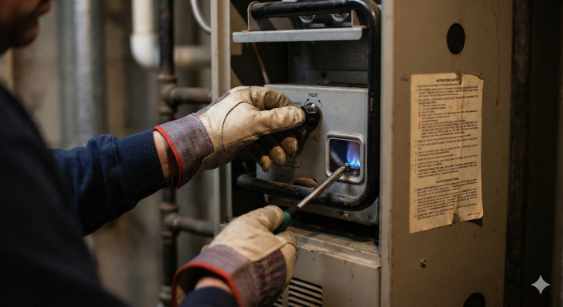
If your pilot light is out, your furnace will not heat. First, check for a “rotten egg” gas smell. If you smell gas, evacuate immediately and call your utility company from a safe location. If there is no smell, you can attempt to relight the pilot by following the manufacturer’s instructions, which are typically printed on a label inside the furnace’s access panel.
A pilot light that’s out is often fixable, but safety must come first.
- Safety First: If you smell gas, leave your home immediately. Do not use phones or light switches.
- Check Instructions: Every furnace is different. Read the specific relighting steps on your unit.
- Follow the Steps: The process involves turning the gas knob to “PILOT” and using the ignitor.
- Call a Pro: If the pilot won’t relight or won’t stay lit, a safety component like the thermocouple is likely faulty and needs professional repair.
Table of Contents
- Does My Furnace Even Have a Pilot Light?
- Safety First: What to Do Before Relighting
- How to Relight Your Furnace Pilot Light (Step-by-Step)
- Troubleshooting: Why Won’t My Pilot Light Stay Lit?
- Frequently Asked Questions About Pilot Lights
- When to Call a Professional
Does My Furnace Even Have a Pilot Light?
The first step is to know if your furnace has a “standing pilot light.” Most furnaces installed in the last 15 years use an electronic ignition, which doesn’t have a constant flame.
You likely have a standing pilot light if:
- Your furnace is older (typically 15+ years).
- You can look through a small viewport on the front and see a small, constant blue flame.
- Your furnace does not make a “clicking” or “glowing” sound before the main burners ignite.
If your furnace clicks or glows to ignite, you have an electronic ignition, and these steps do not apply.
Definition: Standing Pilot Light
A standing pilot light is a small, continuously burning flame inside your furnace. It serves as the ignition source to light the main burners when your thermostat calls for heat.
Safety First: What to Do Before Relighting
STOP. Your safety is the #1 priority.
Before you do anything else, stand near the furnace and smell carefully. Natural gas is odorless, so utility companies add a chemical called mercaptan, which smells like rotten eggs or sulfur.
- IF YOU SMELL GAS: DO NOT touch any light switches, use your phone, or create any sparks. Leave the house immediately. Once you are a safe distance away, call your gas utility’s emergency line.
- IF YOU DO NOT SMELL GAS: You can proceed. Find the step-by-step relighting instructions printed on the furnace’s access panel. Read them thoroughly before starting.
How to Relight Your Furnace Pilot Light (Step-by-Step)
While instructions vary, the general process is as follows:
- Locate the Gas Valve: Find the gas valve knob inside the furnace. It typically has settings for “ON,” “OFF,” and “PILOT.”
- Turn Knob to “OFF”: Turn the knob to the “OFF” position.
- WAIT 5 MINUTES. This is a critical safety step. It allows any residual gas in the chamber to dissipate before you introduce a flame.
- Turn Knob to “PILOT”: After 5 minutes, turn the knob to the “PILOT” setting.
- Press and Hold: Press and hold down the knob (or a separate red button, on some models). This manually overrides the safety valve to allow gas to flow to the pilot.
- Light the Pilot: While still holding the knob down, light the pilot. Most furnaces have a red “ignitor” button you push (which creates a spark). Older models may require you to use a long lighter to light the pilot manually.
- Keep Holding: Once the pilot flame is lit, keep holding the knob down for 30-60 seconds. This heats up the thermocouple, a safety sensor.
- Release Slowly: Release the knob. If the pilot flame stays lit, you have successfully heated the thermocouple.
- Turn Knob to “ON”: Turn the main gas knob back to the “ON” position. You should hear a “whoosh” as the main burners ignite, and your furnace will begin to heat.
Troubleshooting: Why Won’t My Pilot Light Stay Lit?
If your pilot light won’t relight or goes out as soon as you release the knob, you almost certainly have a faulty safety component.
The most common cause is a bad thermocouple.
Definition: Thermocouple
The thermocouple is a safety sensor that sits in the pilot flame. It generates a tiny electrical current when hot, telling the gas valve that a flame is present and it’s safe to open. If the pilot light goes out, the thermocouple cools down, stops the current, and the valve shuts, stopping the flow of gas.
If the thermocouple is old, dirty, or broken, it can’t tell the gas valve to stay open, and the pilot light will not stay lit. This part is not optional; it’s a critical safety device that needs to be replaced by a professional.
| You Can Try This | Call a Professional For This |
| Relighting the pilot light one time (no gas smell). | You smell gas. (Call the gas company first, then us). |
| Following the specific instructions on your unit. | The pilot light will not light at all. |
| The pilot light lights but goes out as soon as you release the knob. | |
| The pilot light is lit, but the flame is weak or yellow, not blue. |
Frequently Asked Questions About Pilot Lights
Is a pilot light that’s out dangerous?
Not immediately. The thermocouple safety device is designed to shut off the gas flow to the pilot if the flame goes out. The danger comes from a faulty valve or improper relighting procedures.
How do I know if I have a thermocouple?
If you have a standing pilot light, you have a thermocouple. It looks like a small copper rod or tube positioned right next to the pilot flame.
Why is my pilot flame yellow instead of blue?
A pilot flame should be a strong, steady blue. A yellow, flickering flame indicates it’s dirty or not getting enough oxygen. This is a sign of poor combustion and should be cleaned by a professional.
How much gas does a pilot light use?
A standing pilot light burns a small but continuous amount of gas all day, every day. This is one reason they were phased out in favor of more energy-efficient electronic ignitions.
Can I relight the pilot light on my boiler?
Yes. Many older boilers also use a standing pilot light. The relighting process is nearly identical to the one for a furnace.
My furnace is clicking but not lighting. Is that a pilot light issue?
No, that is a sign of an electronic ignition system. The clicking is the spark ignitor trying to light the gas. If it fails, you have a different problem that requires a professional.
When to Call a Professional
A pilot light that won’t stay lit is a clear sign your furnace has a failed part. Given that pilot lights are only on older furnaces, this is also a strong indication your system is aging and may have other safety or reliability issues. An inspection from a qualified technician is essential.
By: The Team at Tim’s Heating & Refrigeration
Last Updated: November 10, 2025
Credentials: Otter Tail County’s trusted choice for HVAC service with over a decade of experience in residential and commercial heating systems.