
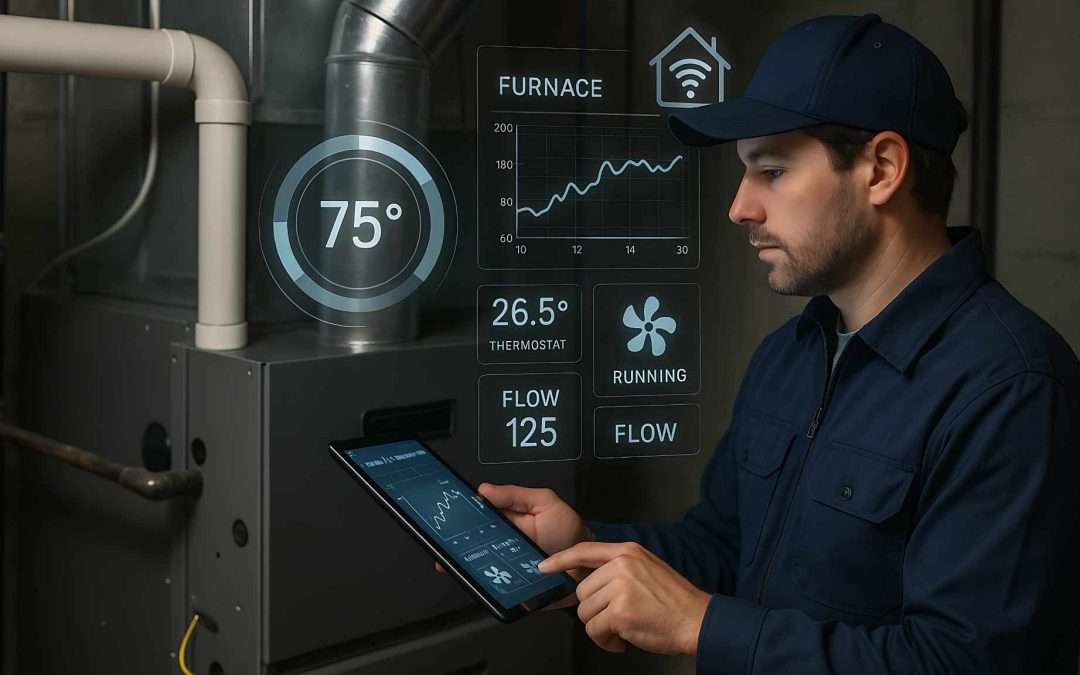
You can increase furnace efficiency by scheduling an annual professional tune-up and cleaning or replacing your filter every 1-3 months. Additionally, use a programmable thermostat to lower temperatures at night, seal air leaks around windows and doors, and ensure your home’s insulation is adequate. These steps reduce your furnace’s workload, saving energy and lowering your monthly heating bills this winter.
Lowering your heating bill is possible with these proven steps.
- Get a professional tune-up to restore your system’s performance.
- Install a programmable thermostat to optimize your heating schedule.
- Seal air leaks around windows, doors, and electrical outlets.
- Keep your furnace filter clean to ensure proper airflow.
- Run your ceiling fan in reverse (clockwise) to push warm air down.
Table of Contents
- What Does “Furnace Efficiency” Really Mean?
- Four Ways to Increase Your Furnace’s Efficiency
- Tip 1: Schedule a Professional Furnace Tune-Up
- Tip 2: Upgrade to a Programmable or Smart Thermostat
- Tip 3: Stop Heat Loss by Sealing Leaks
- Tip 4: Don’t Neglect the Basics (Filters and Vents)
- Frequently Asked Questions About Furnace Efficiency
- Stop Paying for Wasted Heat This Winter
What Does “Furnace Efficiency” Really Mean?
When most people talk about furnace efficiency, they think of the AFUE rating—a number that tells you how much fuel the furnace itself converts to heat.
But true home heating efficiency is about more than just your furnace. It’s about your entire home working as a system. Even a brand-new, 97% AFUE furnace will waste money if heat is constantly escaping through drafts and poor insulation.
These tips focus on improving that whole-home system to keep the heat you pay for inside your house.
Tip 1: Schedule a Professional Furnace Tune-Up
This is the single most effective way to restore your furnace’s lost efficiency. Over time, components get dirty and fall out of adjustment.
During a professional tune-up, a technician will:
- Clean the burners and flame sensor for efficient combustion.
- Clean the blower motor and components for proper airflow.
- Check and adjust the gas pressure to ensure it’s not burning too much fuel.
A clean, well-calibrated system doesn’t have to work as hard, which translates directly into lower energy bills.
Tip 2: Upgrade to a Programmable or Smart Thermostat
A programmable thermostat is a powerful efficiency tool. There is no reason to keep your home at 68-70°F when you are asleep or at work.
By setting your thermostat back 7-10 degrees for 8 hours a day, you can save as much as 10% on your heating bills. A smart thermostat makes this even easier by learning your schedule or allowing you to control the heat from your phone.
Tip 3: Stop Heat Loss by Sealing Leaks
Your furnace can be working perfectly, but if your home is full of small air leaks, you are paying to heat the outdoors.
Definition: Building Envelope This term refers to the separation between the interior and exterior of your home (walls, attic, windows, foundation). A “tight” envelope has very few air leaks, while a “loose” envelope is drafty and inefficient.
Use caulk and weatherstripping to seal drafts around windows and door frames. You can also use foam gaskets behind electrical outlets and light switches on exterior walls to stop hidden drafts.
Tip 4: Don’t Neglect the Basics (Filters and Vents)
We mention it a lot for a reason: a clogged furnace filter is the #1 enemy of efficiency. A dirty filter restricts airflow, forcing the furnace’s blower motor to work harder and run longer. Check your filter every 30 days.
Also, walk through your home and ensure all your supply and return air vents are open and not blocked by furniture, rugs, or drapes.
Frequently Asked Questions About Furnace Efficiency
How much money can a furnace tune-up save me? A tune-up restores a system to its peak performance. It can prevent the 5-10% efficiency loss that a dirty, uncalibrated furnace can experience, which directly lowers your monthly bill.
What temperature should I set my thermostat to in winter? A good starting point is 68°F when you are home. According to the Department of Energy, this is the best balance of comfort and savings. Lowering it at night or when you’re away saves even more.
Is it true it takes more energy to reheat a house than to keep it at one temp? This is a common myth. Your furnace uses the most energy when it’s actively trying to maintain a high temperature against the cold outside. You will always save energy by lowering the temperature (a “setback”) for several hours.
How do I know if I have enough insulation? A quick visual check of your attic is a good start. If your insulation is level with or below your ceiling joists, you almost certainly need more. Adding insulation is one of the best long-term investments for energy savings.
Does running my ceiling fan in winter really work? Yes! Heat rises. Running your ceiling fan on its lowest speed in a clockwise (reverse) direction gently pushes the warm air trapped near the ceiling back down into the room, making you feel warmer.
Is a new high-efficiency furnace worth the cost? In a cold climate like Minnesota’s, absolutely. Upgrading from an old 80% AFUE furnace to a new 95%+ model can cut your heating bills significantly, often paying for the upgrade in just a few years.
Stop Paying for Wasted Heat This Winter
Improving your furnace’s efficiency isn’t about one single fix—it’s about several small, smart steps working together. By getting a professional tune-up, optimizing your thermostat, and sealing drafts, you can ensure your home stays warm and your heating bills stay low.
By: The Team at Tim’s Heating & Refrigeration
Last Updated: October 10, 2025
Otter Tail County’s trusted choice for HVAC service with over a decade of experience in residential and commercial heating systems.